PLANETARY HOSPICE 2025
Becoming Spiritual Midwives for a Hotter, Wetter Earth

“In the buddhadharma there’s no word for hope, because hope takes us out of the present moment. The present moment, brief as it is, is our gift, our choice point.”
Joanna Macy (1929-2025)
To honor the passing of Joanna Macy, I thought I’d re-visit the paper she championed way back in 2014. The overwhelming response at that time prompted me to attempt turning it into a book, at Joanna’s urging. But not far into that, I realized that the audience I was trying to reach - namely, those who were not rationally responding to an existential crisis - was not ready to enter planetary hospice just yet. I changed the working title to “Climate Grief,” eventually settling on “Climate Sense: Changing the way we think and feel about our climate in crisis” (2016). But given the accelerating pace of climate chaos, even that book seems a little outdated to me now.
The continuing interest in that 37-page academic 2014 paper (e.g., 43 views in the last month) baffles me. What I’d prefer people with that level of interest would refer to instead is the deep dive I wrote during the global pandemic, synthesizing Planetary Hospice, Climate Sense, and Climate Trauma (2019) into a 6-part book I’ve made freely available online: Climate Trauma, Reconciliation & Recovery (2022) (available in paperback as well).
But for those who’ve read Planetary Hospice at some point, or who don’t have the bandwidth for a deep dive, I wanted to share my general take on the idea of planetary hospice in light of all that’s transpired since then.
Which is a lot, right? So here’s my 11-year update!
Let us begin with the obvious: from Earth’s perspective, things look a lot worse since I wrote about the end of life as we know it in Planetary Hospice: Rebirthing Planet Earth (2014):
In July 2017, David Wallace-Wells finally broke the chokehold of collective denial with his article in New York Magazine, The Uninhabitable Earth.
XR, Greta, and the Good Grief Project here in the U.S. soon followed.
In November 2019, over 11,000 scientists from 153 countries declared a global climate emergency, warning of "untold suffering" if significant changes to human activities that contribute to climate change weren't implemented quickly.
We’re now passing global systemic tipping points while collectively still frozen in the headlights of the global heat engine. Just this week, thanks to Substack, I learned that a “major ocean current in the Southern Hemisphere has reversed direction for the first time in recorded history, in what climatologists are calling a ‘catastrophic’ tipping point in the global climate system.” Source: Intellinews (ignored by corporate media!).
One premise of Planetary Hospice is look to the oceans if you want to appreciate the scale of this threat.
In 2014, the fact that we’d eliminated >90% of big marine fish boggled my mind, and we’ve since learned that there is not a single area of the ocean that is free from plastics, both refuse and micro-plastics.
The fires in Australia in 2019 killed three billion land animals, while the ‘heat dome’ over the Pacific NW in 2022 killed over a billion sea creatures. Unfathomable mortality.
One bit of good news since 2014 is that the presumed 40-year time lag between cumulative emissions and climate uptake turned out to be closer to 10 years; and, related to that, the worst-case temperature increases diminished from the projected 6-12 degrees Centigrade, or game over, to something closer to a range of 2-5C by the end of the century, which ‘only’ would spell the end of agriculture (at 3.5C) and civilization.
So while the “Near Term Human Extinction” scenarios seem a lot less likely, the premise of Planetary Hospice that seemed so shocking then now seems like a foregone conclusion: life as we have always known it during the 11,000+ year Holocene is ending, and continues to be reflected in our collective psychological unravelling.
That, in a nutshell, is where we stand right now, ca. 2025.
Collective mental illness can be cured, of course, and I’d be remiss not to point out that 86% of the people in the world agree “that their countries should set aside geopolitical differences, such as those regarding trade and security, and work together on climate change.”
That’s remarkable! Don’t you think?
The problem, of course, is that it isn’t given the priority in people’s minds that it demands in terms of real world consequence. Still, it reveals a staggering potential for radical social change that didn’t exist even five years ago. In the U.S., 2/3 of the voters want more action, not regression, from government agencies. That other third, which Trump and the GOP have somehow leveraged into Project 2025, remain captives of their own traumas, lacking the resources to integrate climate trauma into their psyches, and thus acting out in ways that harm all sentient beings.
What, then, shall we do?
From a planetary hospice perspective, this quick update only begs the question: What is the humane response to the widespread mayhem unfolding around us? Climate awareness, which seemed to spring to critical mass around 2017, is now maturing into collapse awareness, thanks to forward thought leaders like Prof. Jem Bendell, UK sociopolitical maven Indra Adnan, and psychotherapist Carolyn Baker. We’ve also begun talking about our situation as a meta-crisis rather than just a climate crisis, which is appropriate and salutary.
In this new light, then, consider how the 5 Precepts for Caregiving from Zen Hospice still hold great promise for containing our compassionate concerns for the world. Put these reminders up on your bathroom mirror, and note how they’re all directed at you, the caregiver:
Welcome Everything. Push Away Nothing.
Bring Your Whole Self to the Experience.
Don’t Wait!
Find a Place of Rest in the Middle of Things.
Cultivate ‘Don’t Know’ Mind.
Another premise of Planetary Hospice is that humans have a way of rising to the occasion in the wake of natural disasters, and we should expect no less of ourselves in a world of unnatural disasters, working to birth a new world we cannot yet see through this fateful shroud of uncertainty.
If you knew Joanna Macy. or are at least familiar with her work, I think you can appreciate from this brief reprise why she championed Planetary Hospice, and even quoted from it in the revised edition of Coming Back to Life: The Updated Guide to the Work That Reconnects (2014). But the common threads in her thinking and my worldview go much deeper, as you will see.
Original Model of Climate Grief
The unique perspective of Planetary Hospice was translated into a model presented to the 2014 Mind & Life Conference at Harvard:
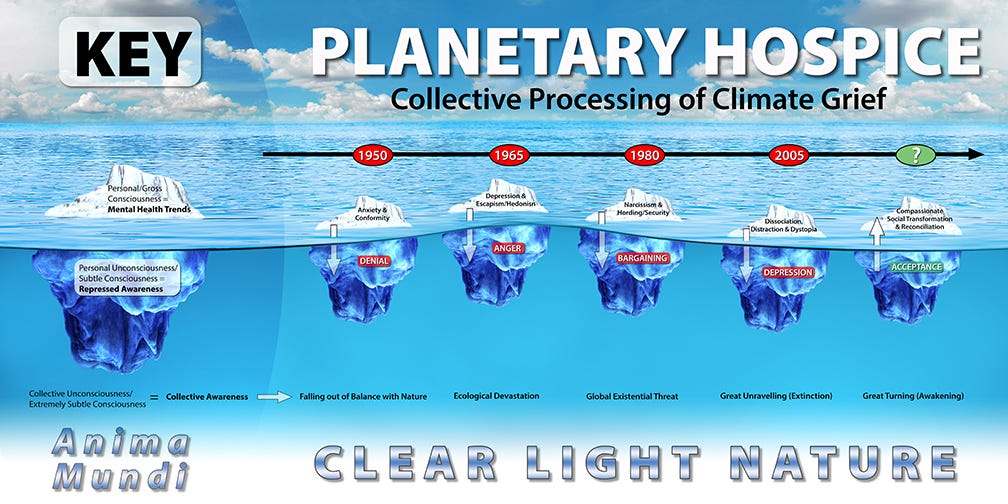
From an ecopsychological viewpoint, climate change is like the tip of the iceberg visible to the human eye, while just beneath the surface of our collective consciousness a far greater crisis is playing out. In fact, it is helpful to think of the oceans themselves as symbolic of our unconscious depths.
Effectively, I assumed what many Earth scientists have since come to accept: that humanity had unwittingly ended the Holocene and entered the Anthropocene at the end of World War II, principally by rupturing our relationship with nature and human nature when we split the atom and unleashed that awesome power by creating Hell on Earth in the Land of the Rising Sun.
In my subsequent research of that cataclysmic event, the nuclear dawn of modernity, I found a poignant prophesy about where our culture was headed from poet and playwright James Agee, shared on the back page of TIME Magazine the week after Nagasaki:
With the controlled splitting of the atom, humanity, already profoundly perplexed and disunified, was brought inescapably into a new age in which all thoughts and things were split - and far from controlled.
While he would’ve lacked the language for it at the time, what Agee was evoking is cultural trauma: a rupture so profound as to cause us to question who we are as a people. In the case of the cosmic bomb that rupture happened to involve the two most fundamental archetypes in the human psyche: God and Mother Earth.
This perplexing identity question, however, was reflexively suppressed in the aftermath of the Great Depression and two World wars. There was no avenue for collective grieving this momentous split with nature, which snowballed into the petrochemical age. While people were still absorbing the shock of liberating Nazi concentration camps, our War Department imposed a news embargo on the horrors we visited on Japanese civilians.
The American Nightmare Visited on the World
So collectively, we suppressed what was up until that time in human history the greatest trauma on the grandest scale, continued to act it out with another 2,000+ nuclear detonations, and proceeded to act out our repressed grief culturally in ways that clearly evoked the stages of grief identified by hospice pioneer Elizabeth Kubler-Ross in her 1969 best seller, On Death and Dying.
The easiest way to see this is by noting the progression of mental illness post-WWII, tracked according to the most popularly prescribed drugs, and seeing the obvious parallels between those masked symptoms and the stages of grief, as summarized in the iceberg model above. This is the aspect of Planetary Hospice that most resonates with people. Cultural trauma turns out to be a very edifying lens in considering the collective pathology that has given rise to our modern “meta-crisis.”
In brief:
suppressed anger is associated with clinical depression. The extreme anger of the late 1960s and into the 1970s, when even sit-coms had an angry edge to them (e.g., All in the Family, M*A*S*H), gave rise to an anti-depressant epidemic, at the height of which 1 in 5 people in the U.S. had a prescription.
The frantic bargaining stage of the 1980s (“Greed is Good”) and 1990s (Reality TV, beginning with Lifestyles of the Rich & Famous) congealed into the toxic politics that is driving the rise in authoritarianism today. Politicians effectively became captives of this fruitless bargaining stage.
As reality started to sink in for the rest of us, dressing in all black became the height of fashion. If that’s not a cultural expression of grief, I don’t know what is.
As we entered a new millennium and scientists began questioning the viability of a future as close as 2050, the popularity of anti-depressants was displaced by an opioid epidemic - pain killers. But there was no increase in the incidence of physical pain. Instead, people were trying to escape the psychological pain of a dying world - they still are, adding the deadly fentanyl to the mix.
Nowhere is this more true than in Trump country, which I contend to be most traumatized segments of our society who are thus the least equipped to take something like climate trauma into their worldview. To this day they prefer to think the weather is being manufactured by the Deep State.
What can we expect when trauma this deep and at this scale goes largely unacknowledged, even as people keep dropping like flies from deaths of despair? To my knowledge, Bernie is still the only pol who has ever uttered the phrase “climate trauma.”
There’s no polite way to put this. Collectively, America has lost its fucking mind! An intervention is long overdue, but we still don’t know what form that might take.
From Climate Denial to Reality Denial
A con-artist Reality TV star with a Hitleresque genius for exploiting unresolved trauma rose to power on the strength, largely, of an empty promise to ‘build a wall’ and revive a mythical gilded age. The American Dream has been dead at least since Obama cried crocodile tears for the climate, selling us out to the banksters and turning America into the #1 producer of fossil fuels, all the while insidiously undermining the climate talks, culminating with the vacuous Paris Accords.
Welcome to Planetary Hospice, right? It’s kind of like the Hotel California - you can check in, but you can never leave.
Looking back now with 2025 vision, I think we actually entered the climate grieving stage of acceptance around 2017, catalyzed by David Wallace-Wells astounding article and culminating with XR successfully getting governments to acknowledge a climate emergency. That’s what acceptance looks like in this collective context. We were on the right track there, and Greta got people to finally begin taking the scientists seriously.
But here’s the funny thing about grieving: we tend to cycle through these stages, and not always in tidy sequence.
Just when it seemed like we were really on the road to acceptance here in the U.S., with the Green New Deal and Native Americans being put in charge of public lands, insane responses to the additional collective traumas of a global pandemic and the globally witnessed murder of George Floyd, events which should’ve served as our wakeup call towards the sixth and final stage of grief - finding meaning in our loss - instead created a backlash against being ‘woke’ which had the effect, collectively, of returning us to the repressed grief stages of denial and anger. The baffling rise of toxic masculinity in the ‘manosphere’ is a perfect expression of that regression.
As I said, collectively America lost it’s mind, suffering a kind of nervous breakdown. Just as we were beginning to settle on the sane objectives of transitioning off of fossil fuels and setting aside 50% of global ecosystems by 2050, we made the fatal decision to put a reality-denying convicted felon, insurrectionist and sex offender into the White House - AGAIN! Even AFTER he’d botched the pandemic response!
That’s KRAY!
I guess I should’ve mentioned that since 2014 we’ve also learned that global warming is impairing our cognitive functions, and that the average American now has the equivalent of 5 bottle-caps of micro- and nano-plastics actively invading our brain cells!
It’s not EASY being a Planetary Hospice Care Provider! The complete uncertainty about future outcomes is difficult in itself to bear, let alone bear witness to. The fact that our patients have become delirious and delusional doesn’t make things any easier.
But remember, we sane ones are still two-thirds of the population here, and 80% elsewhere. So perhaps, if you will allow me to mix metaphors, the virus can still be contained?
Post Script: Palliative Planetary Care
My paper in 2014 anticipated Jem Bendell’s Deep Adaptation movement, which arose from his own academic grieving process a few years later. Characterizing the future in terms of the die-off we are perpetrating in wildlife, insect, and marine life populations, let alone extinctions, I cautioned that:
While on a planetary scale this Great Dying is sure to unfold with an unprecedented amount of ecological disruption and socioeconomic dislocation, and while there is little doubt that in some areas of the world this will precipitate horrific consequences, it is imperative that we as a species continue to value and appreciate whatever blessings and beauty we retain in the midst of global distress and trauma - such as physical health, intimate associations, communal spirit, and human ingenuity, courage, and tenacity. In the face of the very real threat of nuclear extinction in the early Sixties, Dr. King urged human beings to think in terms of the ‘beloved community’ which interconnects all.
I’m happy to report eleven years later that amidst all the chaos, ‘islands of sanity’ are popping up everywhere around the world. Many of these beloved communities, such as the Good Grief Network, have been inspired by Joanna’s Work that Reconnects, which itself has expanded greatly.
Indigenous peoples and cultures, who know what it means to suffer collectively, are also rising up and restoring old, beloved lifeways, while helping us change our relationship to nature’s grasslands, seascapes and forests. It really seems like Joanna’s Great Turning is gaining momentum, approaching the kind of critical mass that can catalyze what (former) IPCC scientist Karen O’Brien calls quantum social change.
All we can do is all we can do, even if it ends up feeling like it’s not enough. After all, if humanity was truly sane, people like Joanna, India’s Vandana Shiva, Austria’s Thomas Hübl, and Karen O’Brien would be household names by now, they’d be world leaders, and we’d be well on the regenerative road to recovery rather than continuing to kick the can down the road to perdition.
With the ascension of Trump, MAGA and profligate fossil fuels, we can be certain that things will get a lot worse before they can ever begin to get better again: worse flooding, worse heat domes, worse climate fires, hurricanes, typhoons, food shortages, resource wars, pandemics ad nauseum. It’s painfully evident. The term Climate Trauma has officially entered the global lexicon. And Rupert Read has now added the idea of the Great Sorrow to Joanna’s Great Turning and my own idea of the Great Dying.
But from the perspective of Buddhist wisdom, we must still avoid the pitfall of extreme views. All these things can be true:
the great unraveling and collapse of Western Civilization is accelerating almost as fast as global warming itself;
the great turning is already underway, a regenerative movement that will eventually gain critical mass and give birth to something very different than whatever it is we might be expecting;
the great dying will continue apace, at least until we begin restoring ecosystems at scale; and,
we will continue to experience great sorrow over what is being lost.
I’ve since come to accept this nonbinary worldview by appreciating the wisdom of an old Taoist master, Pu Liang, who according to Nu Chu entered an awakened realm “where life and death were no more” and for whom “the destruction of life did not mean death... [E]verything was in destruction, everything was in construction.”
This enlightened attitude, called “tranquility in disturbance,” is very congruent with a hospice orientation - maybe we could call it Cosmic Hospice! - and harkens back to Holocaust survivor Victor Frankl’s observation that “[w]hen we are no longer able to change a situation... we are challenged to change ourselves.” The human species will undergo a transmutation in the Anthropocene, no doubt. It’s already beginning with AI. Hopefully, human nature will not be lost in the bargain.
Planetary Hospice was also where I also where I first alluded to Prigogene’s Nobel prize-winning theory of dissipative structures, by which higher order emerges in any system of heightened chaos when a single catalyst suddenly triggers a system-wide, unanticipated crystallization - which sounds a lot like Karen O’Brien’s theory of quantum social change.
So the answers are here. Indigenous led restoration efforts combined with quantum social engineering and collective trauma resolution. What these salutary perspectives point to is not any kind of hope, which is fruitless in the face of such uncertainty; but rather, a new kind of faith that it is enough for us to do our part as activated cells in Gaia’s global auto-immune system.
Gaia may be ill, but her death has been greatly exaggerated, and we tend to grossly underestimate her recuperative capacities.
This represents another evolution in my thinking over the last eleven years. It seemed whenever someone interviewed me regarding Planetary Hospice or, for that matter, Climate Trauma (2019), the same concluding question always came up in the form of a plea:
“Is there any reason for hope?”
In hospice, of course, people coming out of palliative treatment are asked to redefine their hope of survival into hope for a good death - like Joanna modeled for us! At a collective level, this seems to be the basis for Deep Adaptation.
But as the world’s first panpsychologist, what I’ve come to realize is that because we live in an age where faith is mostly absent, people are forced to speak of hope as a proxy for faith. By abandoning unrealistic hope, they implicitly lose faith as well, throwing the baby out with the bathwater. But remember, for most of human history, it is faith that has sustained us, not hope.
People have also, understandably, lost faith in the American Dream - the idea that we can leave a better world to our children. So the meta-crisis is, at some level, a crisis of faith, which doesn’t get talked about enough. In a way, I think this is what Pope Francis was getting at when he tried to spark a global conversation in Ladauto Si’ (ON CARE FOR OUR COMMON HOME) that would engender a new kind of universal solidarity to ground our faith in.
Since cultural trauma causes us to question our collective identity, it’s tempting to reflexively think of ourselves as victims, as indicated by the growing popularity of the term ‘climate anxiety.’ But we’re also the perpetrators of climate trauma on the planet. What does that say about us?
As a care provider in planetary hospice, it’s incumbent upon each of us to get clear on what, if anything, we still have faith in. And whenever anyone asks us that hopey question, it can be very therapeutic to turn it into an exploration of faith.
To be clear, I’m not talking about religion here. Ladauto Si’ itself is more of an ecopsychological tract than anything else. Religious attitudes in the West are proving to be antithetical to climate recovery (e.g., it’s God’s plan, prosperity gospel, Israeli Apartheid, Armageddon, etc.).
Personally, I have loads of faith in Nature - especially Gaia’s higher intelligence, as borne out by Gaia theory’s continuing discoveries. Millions of people who’ve explored sacred plant medicines likely share this faith. And as a Dharma practitioner who rejects Christianity’s destructive myths, I have faith as well in human nature. It’s only when we act against nature and human nature that we suffer trauma, up to and including climate trauma.
But each of us must struggle with and answer this question of faith for ourselves before we can be of any use to others. As the bard Lou Reed once crowed, “it takes a busload of faith to get by.”
And that’s where I’d like to leave Planetary Hospice 2025: as an open question. May you find your own answers. And inspired by Joanna’s example, may we all find peace in the end.