
Deep Secrets & Timeless Truths
The Journey Within on Pilgrimage Retreat


“Maitri may be understood as an expanse full of consciousness which is the realization of genuine buddha [awakened] love. It’s essence is the splendor of buddha nature, the essence of the mind of enlightenment of all beings. The field of maitri is unified because there is a continuity of mind at the level of buddha nature... Since there is such a unified love field, the strength of prayers, the power of wishes, and the blessings of the awakened ones pervade - spontaneously and without effort -the continuous and universal dimension of buddha nature. Space and time are no obstacle to them.
~ Sofia Stril-Rever, from “Kalachakra For World Peace” (Capital Area Tibetan Assoc. 2011)
So far in this pilgrimage series, I’ve focused mostly on set and setting - e.g. my own spiritual container - so that interested readers have the necessary context for the more esoteric truthiness I mean to share. In this, the third installment, we will finally begin unpacking the more meaningful aspects of spiritual retreat and pilgrimage.
It’s been interesting to sit with my own hesitation to share these deep insights. After all, I am a meaning junkie, with these being the most meaningful experiences of my life. Being a compulsive writer as well, what’s not to share? But as you can probably appreciate, our present social milieu doesn’t exactly reward spiritual wokeness! So there’s a certain vulnerability that comes with sharing at this level in such a public way.
The Four Noble Truths transmission at Deer Park kind of kick-started this inward journey for me. I’ve been able to sit with that for some time now. It felt like, after I shared that, I’d be able to get to the real work of pilgrimage and retreat, the esoteric inner development rather than exoteric external truths. Right?
As if.
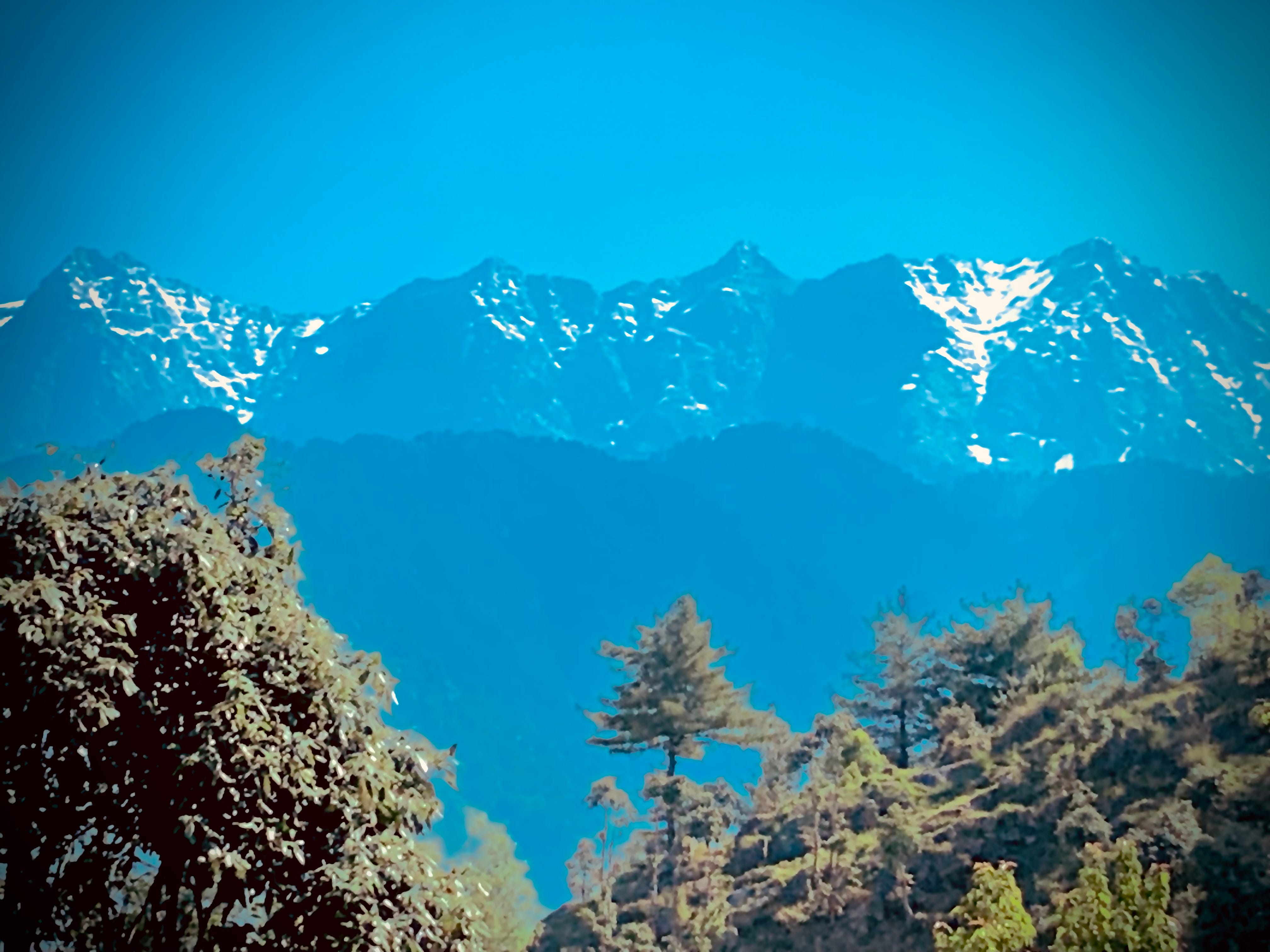
But at least I managed to carve out the necessary sacred and supported space to do extended retreat as part of my pilgrimage, starting up above McLeod Ganj, where Tibetans have been doing solo retreats for many decades now. My ‘cave’ was this beautiful tree-house like loft in the enchanted, off-track Naddi Castle, where they were only too happy to bring me a sumptuous Indian meal every day before noon.
I was able to quickly transition into this new 3-month routine thanks to live Zoom teachings with Geshe Tenzin Zopa that launched at the same time I arrived just down the mountain at Tushita Retreat Center. Once a week, I’d go down to Namgyal, the main temple of His Holiness the Dalai Lama, to do my Kalachakra practice in front of this amazing holy Kalachakra/Vishvamata kaya:


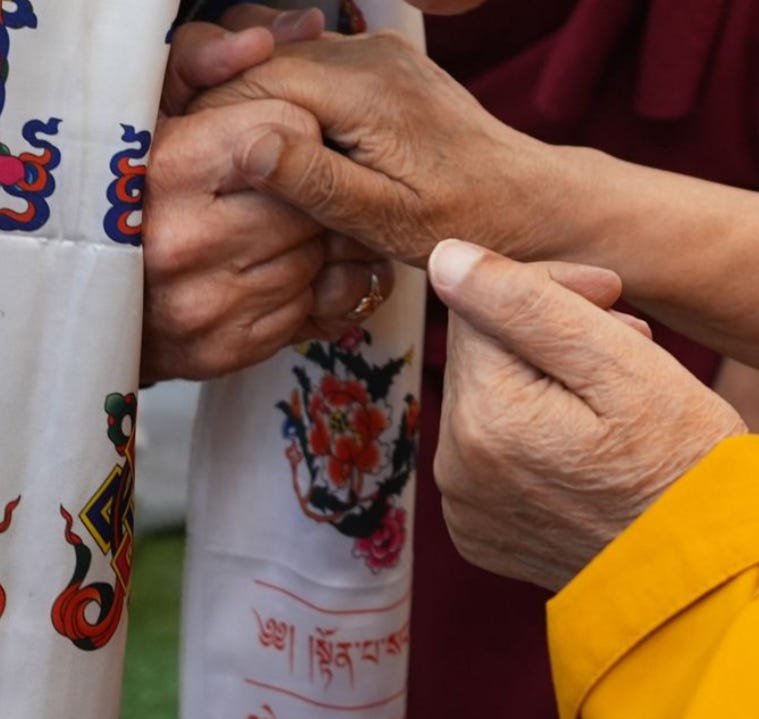
And I even received blessings early on in my retreat from the infinitely vast gaze of His Holiness the Dalia Lama.
So I had every advantage. I better have some results to show!
There is one proviso I wish to append, however, to the very idea of doing ‘solitary retreat’ in anything other than a cave in this particular day and age: the internet is everywhere. In fact, you could probably even get WiFi in that retreat cave!
Now of course one could choose to cut oneself off from the world on an extended solitary retreat, as I’ve always done on shorter 1-4 week group retreats, and as one would certainly do on a more formal 3-year retreat. But here’s the thing: as Mahayana Buddhists, we’re trained not to turn away. Instead, we endeavor to take in all the suffering of the world and use it as fuel for our practice of developing great compassion.
And as someone born in the USA, I could not in good conscience look away from what has been unfolding, beyond belief, every day in my homeland - especially not after having left family and friends behind right after Trump’s election. It’s like a high-speed car crash in slow motion playing out on the most familiar stage of all to me. After all, I love my peeps, and I fervently want them to be freed from this malignant totalitarianism! Not to mention the genocides taking place in Gaza and Sudan right now.
Can you say “survivor guilt”? What a time to go on pilgrimage! So the whole emphasis of retreat for me has become authentically doing my practice for all others, and not just or even primarily for my own spiritual development. I’ve come to realize that, over the course of 25 years of daily sadhana, I’ve really only been paying lip service to practicing for all sentient beings. Having a good guru and going on pilgrimage has a way of forcing you to face your shadow spiritual self.
Still, this choice to stay connected virtually with global developments requires me to walk a spiritual tightrope straddling two vastly different worlds. I want to avoid any pretense here of my having done some kind of pristine, pure spiritual retreat where all experience is blissfully transcendent.
Two worlds. I’m literally in Nirvana right now, as I begin drafting this piece, mostly abiding in superb bliss and tasting maitri, or unity consciousness, now in the fourth month (out of five) of solitude between Naddi Castle and here, in this Nirvana Retreat more than two miles high in altitude. And yet in this very same serene, sacred space I’ve been watching the authoritarian nightmare unfold in the homeland I abandoned, which seems to be coming to a climax on the streets of my hometown, Chicago! It’s night time there when I’m awake here, and then I sleep through their troubles, catching up with my coffee after dawn samadhi, making it seem even more dream-like to me.
And now, as if that weren’t enough fuel for my fire, there has also been a major uprising and toppling of the government in my newly adopted country, Nepal! And then, only days after that carnage, riots broke out here in Leh, killing four, such that I’m now writing under curfew conditions that include the imperious Modhi jamming our internet.
Quite improbably, returning from a cancelled Tibetan mask dance at a nearby monastery on the last day of the annual Ladakh Fest, I was dropped off of a bus at ground zero of the riots, just as the first flash bombs began detonating in the air overhead and protestors began picking up rocks to hurl at the police. I ended up walking through the abandoned streets and shuttered shops of the marketplace, still clueless as to what was going on at that point. Some mask dance!
This is all making for a pretty surreal pilgrimage and retreat experience, as I’m sure you can imagine! And yet it has not in any appreciable way prevented my sojourn from the mouth of Mother Ganges to the headwaters of the Indus River from being filled to overflowing with profound blessings (and melting glaciers). While I think it fair to characterize these feelings as a more spiritual form of survivor’s guilt, I think it would be unfair of you to see it as a form of spiritual bypassing. After all, as I’ve already shared, I am never more with others than when, by myself, I am meditating. Gaia is one big throbbing organism, and caves are embedded in her fascia. I feel you all in this illusory, dream-like world...
Miracles Will Never Cease
I’m reminded here of Tara’s origin myth. The Buddha of Compassion, Chenrezig (Skrt. Avalokiteshvara), after eons of persistent efforts, had finally succeeded in emptying all the hell realms entirely. He then turned away for just a cosmic nanosecond, and when he turned back he saw that they were all full again! It’s said this was the only time, with his great equanimity, that he ever cried - one tear from each eye. His tears fell to the Earth, forming two ponds. Green Tara arose on a lotus flower in one pond, White Tara arose in the other one, and with one voice they vowed to help Chenrezig liberate sentient beings.
That’s like a Mahayana creation story that underpins the notion of bodhisattvas staying in the world, or even taking rebirth in hell realms, rather than entering the blissful realm of parinirvana, as Theravadin Buddhists strive for. And so we have this heartfelt line in our prayer to Chenrezig:
“With the tears of your Great Compassion,
please cleanse all karmas and delusion.”

The sophisticated psychology of Mahayana Buddhism is encoded in its many deity practices which, unlike most religions, are not based on a belief that these deities are ‘real’ or worth dying for. They are spiritual archetypes, basically. The basis of my own deity practice has been White Tara for over a decade now, and somehow She miraculously, from my perspective anyway, manifested in human form (“Nirmanakaya” or emanation body) in The Land of Medicine Buddha (Redwoods of northern California) two summers ago - a prospect I never even imagined to be possible - leaving me no path forward other than to move to the place Khandrola is building for the express purpose of revealing ‘tertons’ - or secret teachings and practices - from the “Great” (5th) Dalai Lama.
The current Dalai Lama directed Khandrola to do so after She’d recovered these hidden teachings, under His tutelege, in Her pure visions (vs. recovering physical tertons). You have to understand here that Buddhist psychology posits progressively more subtle realms of collective consciousness, including unity consciousness, that are accessible to us, contrary to Western psychology’s idea of a “collective unconscious” that is inaccessible to individual consciousness. His Holiness says the world needs to hear these secret teachings right now, in this time of great peril.
Kind of my beat, right?
Khandrola began turning that cycle of teachings last Spring, when my pilgrimage began at the behest of a young monk’s invitation to visit sacred Tara sites nearby - beginning with the ‘talking’ White Tara Samboghakaya (“enjoyment body”) in Thamel (ancient Kathmandu) that urged the Indian saint Atisha to take the Dharma to Tibet before it disappeared from India.

Then talking White Tara Herself, who I think was best described by Lama Zopa as “Great Kindness pervading all the world, acting as companion of great bliss [Padmasambhava],” imparted Her blessings to my pilgrimage and practices during a private audience I had with Her just before continuing on to the holy sites in India. Just as when His Holiness spurred memories of my past life with His blessings imparted at Shoreline Amphitheater in 2001, Her Holiness’ blessings would end up making all the difference in the world on this holy pilgrimage. So if you get any benefit at all out of what I’m going to be sharing here, just know that it’s because of Her, and not just my spiritual vanity.
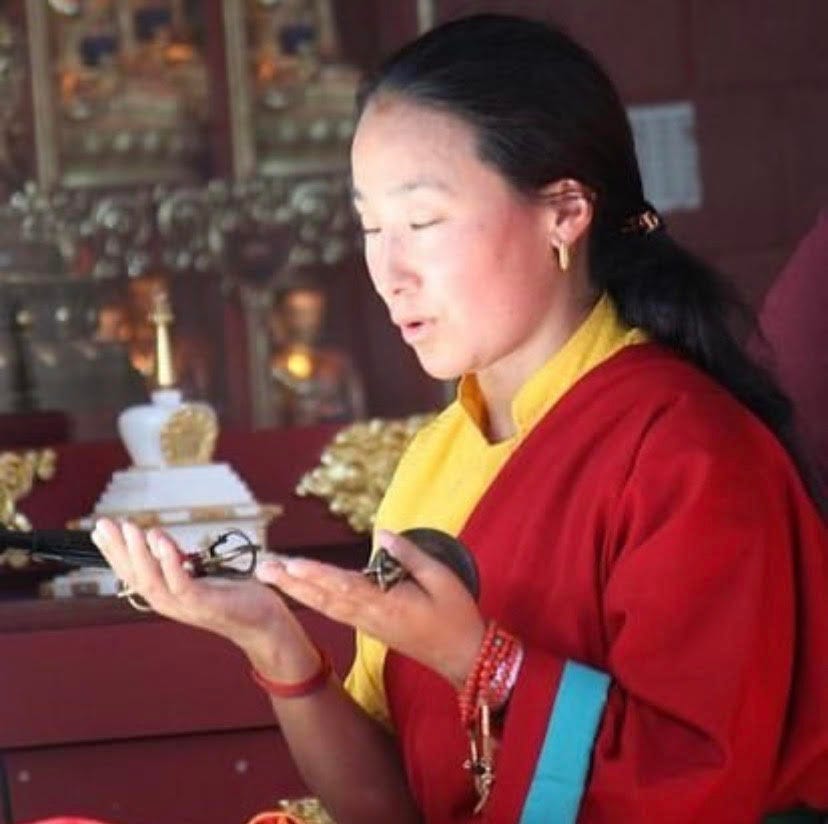
I really wish I could find the words that would adequately describe the ever-present force of those blessings, or the profound effect on my mind of encountering Her in the Land of Medicine Buddha. As Milarepa would say, the phenomenon of the guru’s blessings is beyond playwords. Words fail, and this is why I hestitate at the beginning to even share the results. I can’t adequately describe to you the causes. I’m just not that good of a writer!
But this is The Dharma Beat, after all. And Khandrola will be opening Her new learning center up to the whole world next year. So... I have to at least try.
As one of my other Tibetan teachers likes to say: “We’re all confused buddhas!” Me, I suspect, more than most!
The End of the Beginning
Obviously, what I’m talking about here is a life’s project, not just a single post. But I want to lift it up off the ground here and now. I want to share the profundities with you, in the same way Kerouac was compelled to share the “beatitudes,” which is the spiritual root of the “beat generation” and The Dharma Beat itself. I’m convinced Jack would’ve contributed so much more if he’d just trusted his meditative experiences and dharma studies enough to honor the vows - especially the vow against intoxicants and unwise sexual behavior! At least, he wouldn’t have drank himself to death in a miserable, decade-long depression.
That’s the primal importance of spiritual containers for our minds. Rather than becoming a monk, I went back to school at 55 to study the human psyche, to study the Dharma in depth, and to serve the dying and bereaved at Zen Hospice in San Francisco. The skill set that I walked away with was how to build spiritual containers, in any cognitive space, that are adequate for processing profound sorrow and sublime bliss. While it was my intention to then go into hospice, as a chaplain or social worker, I ended up instead being called to do it at the collective level, in groups, culturally, and in relation to the biosphere.
Strange karma from being born into strange times.
In the immediate wake of XR!’s bursting on the scene in 2019,the pandemic took hold and I began building such such spiritual containers online, in the Zoomiverse. This led, once the pandemic subsided, to working with Tribes on biologic (bison) and ecosystemic solutions to the climate crisis. One thing seems to lead rather seamlessly to another when you are called by spirit, because of course it’s all interconnected.
Pilgrimage is another matter entirely, I think - a unique and precious opportunity to focus on one’s own spiritual container. My own container shape-shifted and crystallized in a way that feels like it brings me ever closer to my guru the longer and further I am away physically from Her! And also ever closer to my beloved others, the farthest I’ve ever been away from all of them. It’s such a strange spiritual paradox that the more I retreat into solitude and my so-called self, the more self subsides and I find all others waiting for me there. Like Rumi’s ‘field.’
Allow me to briefly address this exoterically one last time, and that will finally set us up for the more esoteric explorations we are going to launch into here. Your patience is a virtue that will be rewarded.
The first shape-shift was from two dimensions to three. For many years now, my praxis has been structured by morning and evening tantric deity sadhanas: Kalachakra, or wheel of time; and, White Tara’s Cintacakra, or wish-fulfilling wheel. A ‘wish-fulfilling wheel of time’ practice, in other words.
The deity archetype, deeply engrained in the collective human psyche, is a projection of idealized qualities we aspire to by imitation and imagination, much as modern sports stars visualize successful performances long before actually succeeding. As an example, His Holiness is considered to be the living embodiment of Chenrezig’s great compassion. The sadhana of Chenrezig is thus designed for generating, nourishing, and metabolizing our desire for others to be free from suffering. It’s actually quite rational, a science of the mind.
Similarly, Medicine Buddha is useful for healing our own traumas, freeing ourselves up to help others heal their traumas. Manjushri is for generating wisdom, and etc. Vajrayana Buddhism has a deity for every virtue you could want to develop, which incidentally are the antidotes to all that ails us psychologically.
Simple, and at the same time so profound. Because each sadhana also has aspects for “realizing emptiness” ~ seeing phenomena, including the self, as they really exist, and not as they appear to our conditioned mind, which is the direct antidote to all our habitual delusions and compulsive projections.
Retreat Phenomenology
What I discovered on Naddi Mountain was that, even after 25 years of daily applications, my container was still lacking a key component: an emphasis on simple meditative absorption, without all the ‘bells and whistles’ of active visualizations, prayers and mantra recitations that I so love about deity practice. Thanks to the kind advice of Geshe Zopa, I began at the outset of my pilgrimage retreat to rise before dawn, go directly to my cushion, and just sit zazen, letting go of all gross conceptualizations.
To help inspire this practice, I happened to have some ancient ‘secret teachings’ in my pack from Tilopa, imparted to Naropa on the banks of Mother Ganges more than a millennia ago. I’d read these before bed, and recall them when I’d take the cushion, as they’re all about the power of pristine, pure awareness.
Practice Note: Even first thing in the morning, when our mind is supposedly at its calmest, it still takes me 15-20 minutes to tether my mind to this stake of awareness in the ground of being, as it’s been wandering about freely in and between dreams all night, and that tends to continue on the cushion.
Now once the mind settles, once thoughts, images and emotions subside, we come upon a rather amorphous field of awareness awaiting us there in the supposed ‘darkness’ (in fact, the mind is self-luminous when we pay attention to it). With practice, we’re able to find a place of rest in that field. And when we learn to abide in that ‘ultimate natural state,’ according to Tilopa, all of our hopes, expectations and doubts are pacified.
That, in itself, is kind of blissful.
A mind free of fixation on thoughts and concepts is even said to be ultimate truth itself. The Buddha within. Not us, mind you. Nothing like our self-conditioned mind. Rather, a ‘pure land’, one we can travel to internally, like in dreams awake, there in that open field of uncontrived awareness, whose center is everywhere, and whose ultimate, felt dimension is nontemporal.
Does that sound like something that would appeal to you? That might even be worth sacrificing an hour of sleep for?
Because friend, that’s what awaits us in the cave we’re able to virtually dig out of our nocturnal gloam just before a new day dawns. As I say, that zero-point field is dynamically luminous in its own way. And what I find to be most curious about this field is that there’s a kind of mental flower that grows there, and there’s a jewel in the center of that luminous mind flower. Om Mani Padme Hum is not just a mantra! This jewel in the flower spontaneously appears from that field as an elemental radiance, or spiritual force that we are able to tap into with no effort.
And yes, sometimes it can appear like an eye made of light, looking back at our own unfocused gaze in this field awareness. Recently, as spiritual synchronicity would have it, I saw that first photograph ever taken of a photon of light, and I was really struck by the resemblance to this self-arising flower-jewel!
This not uncommon phenomenon is referred to in guides on Vipassana mediation as the “counterpart.” It also makes an appearance as the zygote in the Secret of the Golden Flower, from the ancient Taoist religion of the golden elixir of life, which I’ve written about here before [Sea Dragons Go There!]. It is also the seminal seed for the “light body” from the Six Yogas of Naropa, also passed on by Tilopa, and perfected by the Tibetan yogi Milarepa in the 11th C.E. Not to mention Kalacakra and all other higher yoga tantras, including Ati (highest) Yoga. Heck, where do you think those patterns in Persian rugs come from? Or the related idea of “flying carpets”?
Any of us can unlock this innate light-seed archetype if we just apply ourselves. Isn’t that in itself astounding?
This is a great big esoteric secret that has been passed down through whispered lineages and perfected in cave retreats since even before the Buddha’s awakening. And get this: if we work with it diligently during the limited time we still have left in this mortal coil, then at the time of death it can serve as a portal to myriad worlds, somewhat hinted at by the tunnel of light in Near Death Experiences.
We can even, potentially, skip the bardo thordol altogether!
That seems like a good place to end this beginning of my pilgrimage retreat story! I have much more to share, but suffice it to add here that the more I sat with this phenomenon - which doesn’t always arise, btw - the more I found that if I could refrain from grasping after it in my mind, for example by remaining focused on the field and not the flower, it really does appear as a kind of portal - to what, I cannot really say - even while we are still in this body. It hints at something that is “beyond” ~ as with the Heart Sutra’s progression from “gate” through “paragate” to “parasamgate”: beyond, way beyond, and beyond even that. I sense it’s at the “way beyond” level, though that’s just an intuitive guess.
So, in conclusion:
Adding this 3rd dimension to my daily sadhanas has really been a force multiplier, and has left my spiritual container feeling much more whole, stable, and meaningful than ever before.
This field-awareness is almost like a ‘dark energy’ reservoir that my other sadhanas draw inspiration from.
In turn, the reservoir seems to be replenished by these other practices.
There’s a natural symbiosis between the absorption/awareness praxis and the tantra/deity praxis.
And now, at the end of this retreat, I can not imagine starting my days any other way than at pre-dawn on my cushion.
That’s my big takeaway from this pilgrimage retreat.
In our next installment, I intend to share the other shape-shift in my approach to sadhana, which has more to do with the compassion wing (vs. the wisdom wing).
Consistent with the spirit of His Holiness directions to Khandrola to broadcast these ‘secret’ teachings from 9 lifetimes ago, I’ve heard very high lamas say that in these critical times, with the existential stakes we are confronted by, the kind of knowledge that has traditionally been kept secret through whispered lineages and so forth must be shared with the world, without regard for the risk of misuse and misapplication. The times demand no less of us. And so, unless my guru Herself instructs me otherwise, I will persist.
Hop on the big bus! (‘Mahayana’ means ‘great vehicle’). Who knows where this road will take us?
Practice Tip: For those who struggle with establishing a meditation practice on the cushion, I highly recommend using pranayama as your portal to both calm abiding and higher states of consciousness. The best way to utilize the breath to induce calm abiding, or quiescence, is to sit down with a straight posture, which opens our psychosomatic channels, slowly deepen and lengthen your breathing, pausing at the top and bottom of each breath, and every 7 or 8 cycles of this ‘round breathing’ expel all the breath out of your lungs and hold it out for a count of 7 or 8 (never straining). Settle into this pattern for 15-20 minutes. This has the proven effect of releasing the anxiety and daily trauma that gets in the way of a quiet mind. Certain kinds of soothing music can be a valuable aid in this practice (e.g., chakra frequencies, singing bowls, etc.). When you’ve reached higher valences of relaxed mind, which will be quite obviously felt in your body, then just let go and rest in that contemplative space. This method has been used for many thousands of years - even by Rosicrucians - but for some reason is rarely taught to beginners.