

This Illusory, Dream Like World
Reflections from a Himalayan Pilgrimage (2nd in a Series)

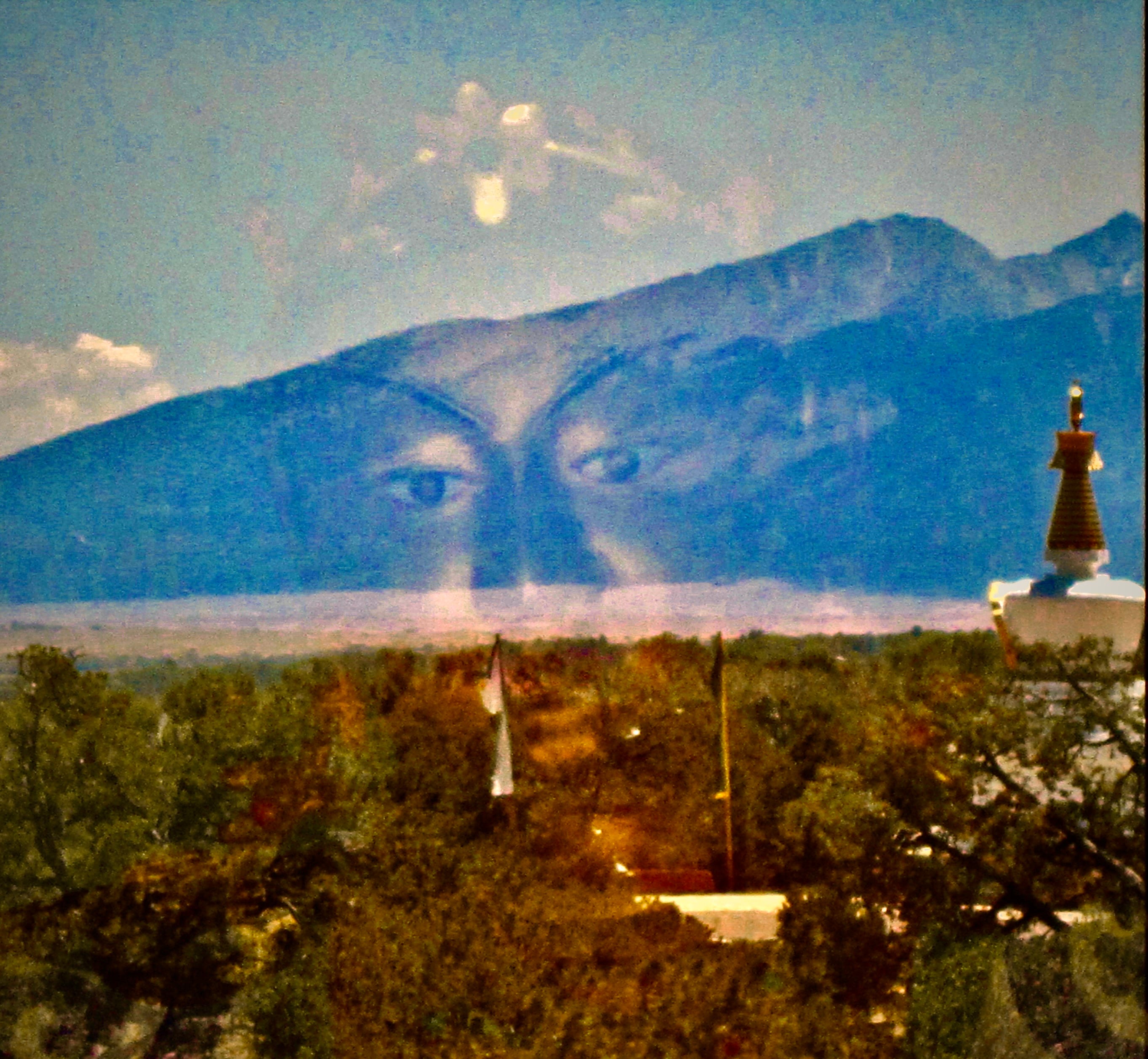
While dreaming, a dreamer is completely immersed in his or her dream and only upon awakening realizes it was a dream. Similarly, the worldlings, absorbed in a dream produced by their ignorance, hold the illusory as real; however, the buddhas have awakened from that dream and freed themselves from the fetters of ignorance.
~ Buddha
Going Forth
Why a pilgrimage? Or more broadly, what is the point of spiritual adventure? It’s a reasonable question. In a dying world, something like spiritual pilgrimage could be viewed as a naval-gazing relic of the past. So before sharing the more esoteric results of my pilgrimage, I want to begin by explaining the idea of taking pilgrimage in the first place. It is not something I’d planned or even always intended. It just seemed to happen!
There’s an old cliche about going out into the world to “find yourself,” only to find in the end that what you were seeking lies within, and always has. While there is truth in that, this cliche is sometimes misinterpreted to imply that such world adventures are spiritually useless, or even psychologically naive.
Nothing could be further from the truth.
Think about it. Jesus went into the desert for 40 days and 40 nights of fasting. Mohammed found his light in the darkness of a mountain cave. St. Francis was big on pilgrimage, living the life of a mendicant. Buddha left his royal home behind, wandered to holy places and holy teachers for seven years. Even after awakening under the Bodhi Tree, the newly awakened one wandered silently all the way to Varanassi and Deer Park.
Pilgrimage is obviously an important spiritual experience in every religious tradition, not something to be casually dismissed or equated with new age spiritual hedonism. Imagine how different the world would be today if every young adult was encouraged to go on pilgrimage, vision quest, or world trek for a ‘gap year’ or two before deciding what to do with their lives. Wouldn’t it be a better world than the one we’ve got now, a world where those same kids can’t even see a viable future for themselves because of runaway climate change and an overheating economic engine?
Experientially, however, the point of spiritual adventure is not that we will ‘find ourselves’ at any particular far-off place. The holy man on the mountain top is deservedly the butt of many jokes. Instead, the point is that it’s extremely difficult to transform ourselves spiritually without getting away from the habitual life we’ve become accustomed to, surrounded by all the people who continually reinforce our various habitual roles and identities in our limited sociocultural settings.
How much of our workaday lives is spent meeting or falling short of the expectations of others? That can be spiritually stifling in itself. As Freud himself said, the best that can be done for people in such a spiritually numbing culture is to make them less unhappy. And that’s what most people settle for - especially if they have access to prescription drugs that make life less unbearable.
Going forth into the world, into the relative unknown, is the great leap of spirit that most find so difficult to surrender to, even if they are spiritual and have had the thought or inclination to go forth into the world in such a way. But the reward for taking that plunge into foreign climes, free from any kind of professional or family obligations, is that you are able to easily leave your old skin behind, and learn spontaneously how you most comfortably interact with others in any given setting, as well as who you really are in solitude, especially in natural settings.
Transpersonal psychologist Michael Washburn posits that we’re born very close to our spiritual pole, especially the first seven years or so. Then, as adolescents, we’re encouraged to reject that more relational way of being in favor of strengthening our egoic pole. From that point forward, we are rewarded for actively suppressing our spiritual needs in favor of society’s needs. If we’re lucky, Washburn posits, we get to a point of ‘mid-life’ crisis where we realize that even if we’ve been playing the game of life by the rules society creates - there are no winners in this game!
And this realization then triggers the suppressed spiritual pole to volcanically erupt from deep within our psyche, often shattering the ego in what Stanislav Grof characterizes as a ‘spiritual emergency,’ from which our long-suppressed spirit will re-emerge if the individual is supported. But society has traditionally treated these distressing episodes as mental breakdowns or psychosis, and thwarted the natural process of spiritual breakthrough and catharsis with spirit-numbing medications. This has the practical effect of trapping that person perpetually in their state of arrested crisis.
I was lucky enough to have that mid-life crisis when I was 35, and to be in the care of a kind family of Deadheads and Rainbow who were spiritual, too, and supported me all the way through psycho-spiritual death and rebirth. They were my container when my own container broke wide open.
No white picket fence for me
I was a spiritually motivated person from the time of losing my father as an immature 19-year-old. But my spiritual path didn’t really begin until I walked away from a successful career in environmental law at 33. Up until then, spiritual pursuit for me had all been just fantasy and delusion. Mostly, I was too busy conforming to the roles society expected of me, and then coping with the consequences; e.g., through drinking a lot, skiing a lot, and escaping into mountains and rivers when I could.
And when it came time to settle down and marry I, the only single person in my office, resisted. I was convinced there was more to life than career success, social acceptance, bowling night, and raising kids. In fact, the more I backpacked in the Rockies, the more convinced I became. The natural world has always had an irresistible gravitational pull on my spirit.
So while still a young man, having proved my mettle in the corporate world of intergovernmental relations, I secretly fell in awe of Peter Matthiessen’s spiritual adventure book, Snow Leopard, recounting his epic journey to Crystal Mountain in the Inner Dolpo region of Nepal, with his biologist friend who was tracking wild blue sheep, or bharal. I immediately began plotting my own escape from the land of my birth. I knew without knowing that I had to hike in the Himalaya while still young, still at peak health.
Working my first salaried job in the public sector, with an income deferment option, afforded me the privilege of buying my freedom for a couple of years. I had very little concern what might happen after that. To me, the law was always a means to an end, and this seemed like a worthy enough end.
“To experience the world” - that much, at least, seemed entirely logical to me. More logical than prolonging career success indefinitely with no end in sight. So with head-hunters offering to double and triple my salary, I made the best decision of my life: to politely decline, and walk away from that pinstriped world of corporate culture.
I will confess that I briefly toyed with the idea of becoming the City Attorney for Aspen, Colorado, maybe even a regular at the Woody Creek Tavern. To become a Gonzo lawyer, in effect. But instead I took the leap, purchasing round-the-world airfare valid for all of 1991. Soon I would find myself boarding a plane from San Francisco to Oahu, Rarotonga, Fiji, New Zealand and Asia.
And what they say is absolutely true: the world will humble you, if you give it half a whirl. In so many ways, the world will humble you!
As Washburn might say, if you’re really lucky, the world will break you, enabling you to become who you were meant to be all along - which is never the person any and everyone expected you to be. As unappealing as that might sound to most reasonably successful people, the truth is that everyone I’ve ever met who has this shared experience in their past turned out so much happier as a result!
There is still a lot of social stigma attached to the idea of having a breakdown. We’re all about ‘keeping it together’ no matter what. But as a wise monk once told me, “the only difference between a breakdown and a breakthrough is whether or not you have the right support system around you.”
Stanislav Grof is right. Spiritual emergence is one of life’s greatest gifts, even if it happens to come wrapped in existential dread and personal turmoil!
Grateful Dead
So yes, I suffered a complete mental, emotional and spiritual breakdown after returning from my big spiritual life adventure overseas; and yes, it was the hardest thing I’ve ever had to go through. Feeling like a broken human being, a total failure at life, really sucks. It is completely understandable to me why someone might choose to end their lives at such a low point.
In fact, speaking for myself, it felt like I’d already died inside before I broke down. My psyche was shattered. I could no longer sleep. My spirit was gone beyond. It was perplexing to me that my body was still animated in a way that felt so foreign now. A voice inside of me we ready to give up the ghost, for sure. But my spiritual family wasn’t going to let that happen, and we were together around the clock.
If you’re able to come out the other side of this darkness, then suddenly a wholly new and different world of light opens up before you. Much like the death rituals of the Elysian mysteries, I imagine. My spiritual death happened after the Oregon Country Fair, on the road, and my spiritual rebirth and intense healing journey began on Jerry Garcia Band summer tour, with my Rainbow Family of Light - Guru, Brother Love, Eclipse, Windy, Beth, Maya, Sweet Melissa, and my hippie dog Gaia - and 2000 hits of LSD in a VW Van that became known as the ‘healing bus,’ because we kept drawing people who needed to be spiritually healed and we had the sacred space (slang at the time for LSD).
How could you not be re-animated to life with Uncle Jerry crooning out the gospel of love and light like this night-after-night under the moon and stars:
If we walk together, little children
We don't ever have to worry
Through this world of trouble
We gotta love one another
Let us take our fellow man by the hand
Try to help him to understand
We can all be together, forever and ever
When we make it to the promised land...
But that’s another story!
Flashbacks
At some point on that long, strange trip, sometime around 1995, sitting on a park bench reading The Way to Freedom by the Dalai Lama, I suddenly remembered I was Buddhist!
Meditation had always come quite naturally to me, and I’d been taking refuge ever since that breakdown, finding sacred healing space deep inside the dark cave of my mind - even amidst acid-fueled all night raves in our Berkeley warehouse squat. It was like finding this perfect implicate order underneath all the disorder by going under the waves, into the ocean’s abyss. Once you find it down there for yourself, it’s totally reliable, and it becomes your best friend - you can return to it again and again. That is the true spirit of refuge.
So remembering I was Buddhist was just like recovering deeply buried memories. It all seemed familiar to me in a way that the Catholic mass never did when I was growing up. And with the blessings from His Holiness, imparted in the summer of 2001 at the same Shoreline Amphitheater where we had all danced to Jerry under the stars in 1992, while on extended Medicine Buddha retreat on Cloud Mountain, sitting and listening to a creek one day with deep mental quiescence, a flood of vivid memories welled up spontaneously from the end of my last incarnation as a cave dweller in Tibet during the Chinese invasion. That would’ve been the summer of 1956, the year before I took rebirth.
And just like that, it became clear as that mountain stream why I’d been so drawn to the Himalayas a decade earlier! A Tibetan practitioner reborn into a nice Roman Catholic family, at Resurrection Hospital in Chicago, under the Buddha’s eclipsed full moon in 1957. And it was equally clear why that failed construct of an identity had to be broken down so completely in order for me to realize, or remember, that it was just a construct in the first place...
Most serious Buddhists come to realize emptiness of self in a more orderly, supported fashion. My strange karma was to experience it directly before ever even having heard the term “emptiness of self” or shunyata. That same monk who revealed the fine line between breakdown and breakthrough went on to advise me that my challenge was to patiently integrate that traumatic experience after-the-fact by developing the intellectual foundation that was missing when I experienced it, so that the trauma could then be released, ushering me into a sea of profundity.
This is my backwards karma, a pattern that has been pretty consistent on my dharma path ever since. I tend to experience things directly at first, learn about where they fit into the 8-fold path afterwards, then integrate the experience, and then move on to the next great mystery.
Of course, I’m just one of more than a million poor souls the Chinese Red Guard slaughtered in Tibet during those years of ‘cultural revolution,’ and by no coincidence one of millions of Buddhists re-born in the U.S. after October of 1950, when the invasion began. We are the first such generation of Buddhists born in the Americas. We transmigrated over here just as the Beat Generation, inspired by early translations of Buddhist texts, was taking hold.
As a Tibetan in the 1950s, it only stands to reason that you’d actively create the causes and conditions to be reborn your next life in a promised land, a land of milk and honey where you’d have plenty of leisure time for dharma practice, as well as access to the Dalai Lama’s teachings without fear of imprisonment, torture and death.
The Chinese Red Guard had a great big advantage over us cave dwellers and monastics - we were more afraid of killing than we were of dying! Easy pickings.
So recalling this now at the age of 44, then reconnecting with the tantric thread of my predecessor’s mind-stream, I came to accept that it was just a matter of time before I’d return to these Himalayan sacred mountains for good.
Rising Up
The Himalaya are the tallest and youngest mountains in the world, which makes them feel more alive than all the others I’ve traversed. It’s very easy to see how these, the tallest peaks in the world, were so very recently, geologically speaking, at the bottom of the ocean.
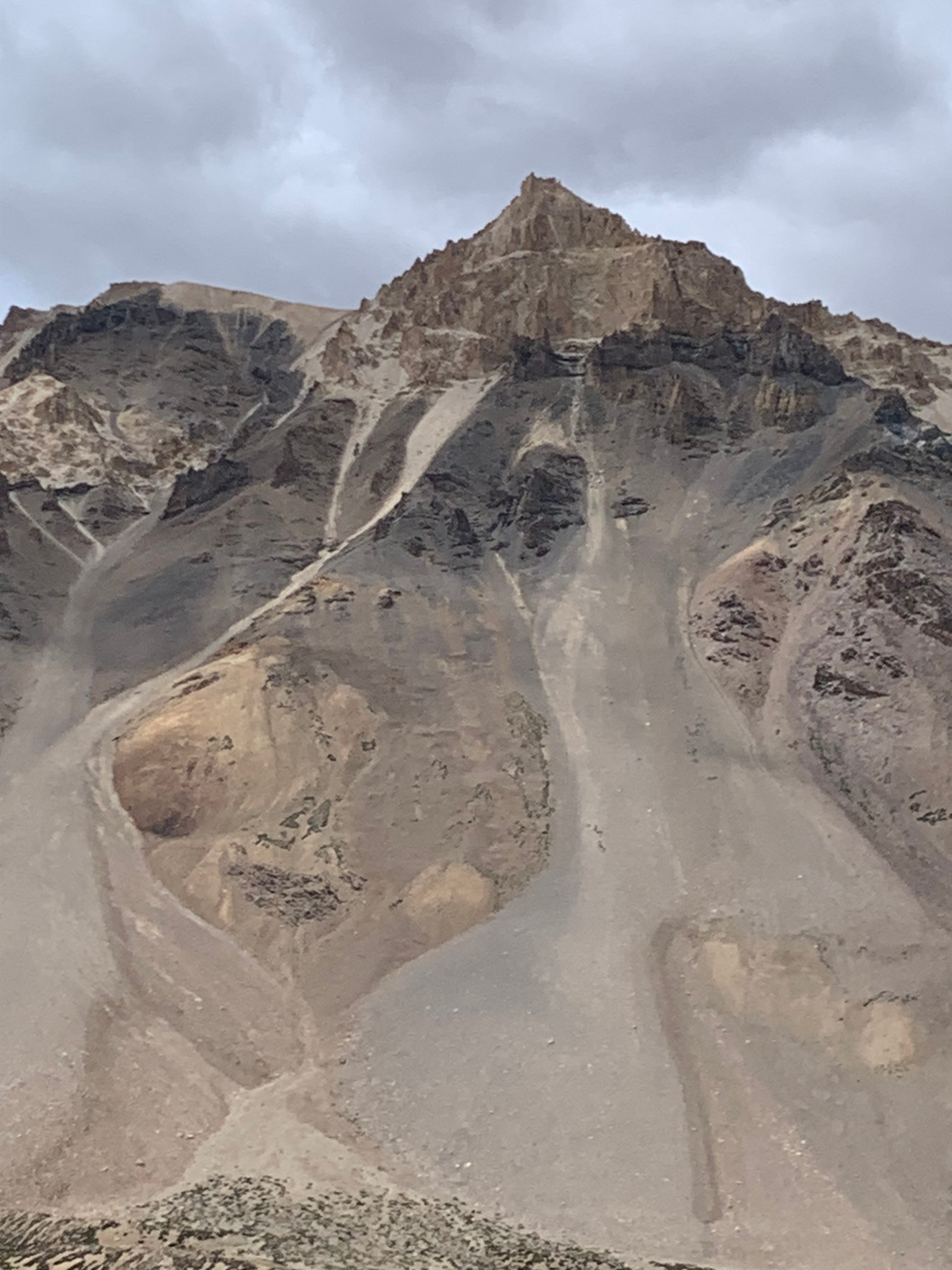
Unique among all the world’s mountain ranges - with the possible exception of the Urals, from which shamanism emerged 8,000 years ago to germinate the world’s religions and mystical traditions - there are lots of humans fully awakening inside caves in these mountains to this very day. And this has been going on for thousands of years! It’s quite remarkable, no?
The human spirit!
As it turned out, I did the first 3 moon cycles of my own solitary retreat on the same Naddi Mountain, high above McLeod Ganj, where Tibetan monks and nuns have been doing solo retreats since being forced out of their homeland. They’re spiritual and political refugees living in deep refuge, which hermitage I only discovered after settling into Nadi Castle down the trail. The quality of silence on Naddi Mountain has a cumulative zhigpa, or karmic force, behind it. The air is clean and pure up there. The mountain itself, welcoming.
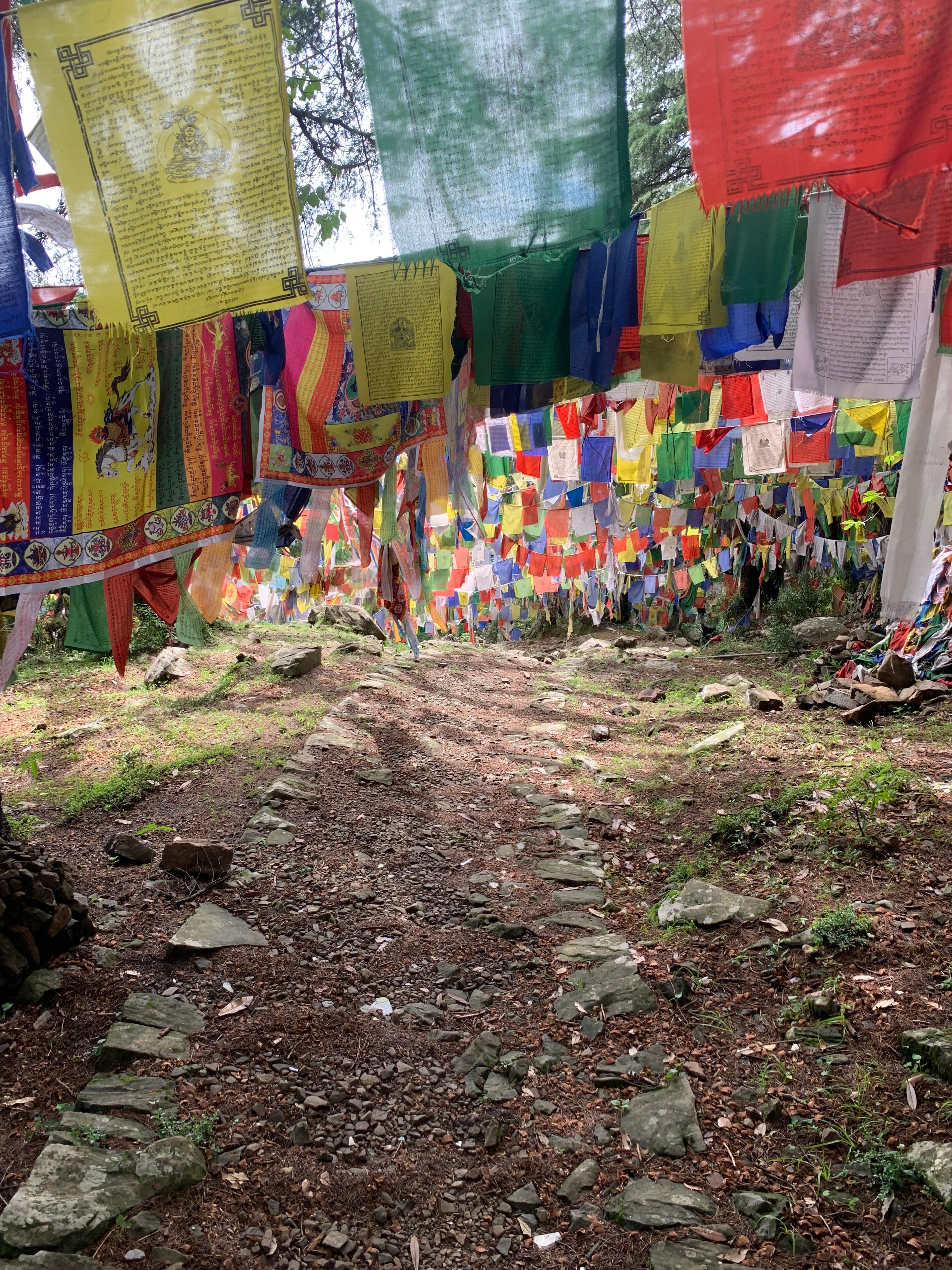
I was so happy as part of my pilgrimage to offer mandalas to, and circumambulate with mantras, the white marble-floored Tower Stupa in that sanctuary, just a ten-minute hike from my own place of refuge. Tower stupa is a reliquary for a tutor of the Dalai Lama, Kyabje Trijang Rinpoche, who once urged a young student of his to take the Buddha Dharma to the West, including to California during the 1960s, where he inspired a young L.A. flower girl turned schoolteacher to give up her life and become a powerful Jewish American Tibetan nun. Two decades later, Bikshuni Thubten Chodron would become my root teacher, go on to found Sravasti Abbey in Washington State, and in her ‘spare time’ complete a ten-volume Library of Wisdom & Compassion with His Holiness the Dalai Lama.
Ven. Chodron, presently in her 75th year, is living Buddhist history, revered all over the world - a great Dharma figure people will still be talking about centuries from now. I stumbled onto her in 1999, on Cloud Mountain, by typing “Buddhist Retreat” into the search engine of the world wide web - the very first thing I ever did on the internet. After taking lay refuge vows with her, Ven. Chodron gave me the dharma name that I’ve identified with ever since - Zhiwa, which means ‘Nirvana’s peace.’
And now here I am finishing my pilgrimage at Nirvana Retreat, in the shadow of Shanti (Sanskrit equivalent of Zhiwa) Stupa, which opened in 1991 as a world peace stupa built by the Nicheren school of Buddhism from Japan, with relics of the Buddha interred within. 1991 was the same year I’d tried and failed to get here the first time, before I’d remembered I was Buddhist, right around the time this stupa was being consecrated.
Karma is weird!
Back to the Future: Pilgrimage & Retreat Symbiosis
You’ll have to excuse me for coming unstuck in time whenever I try to open up about my life in the Dharma. The Buddha said “all three times” - past, present and future - “are an equality.” Plus, I was initiated into the Wheel of Time (Kalacakra) in 2011 by His Holiness, which unmoors one even more from temporal and linear conventions.
After leaving Naddi Castle in the middle of monsoon season, I traversed Himachal Pradesh by hired car and entered Ladakh through the Lahoul & Spiti Valleys, visiting all kinds of amazing holy sites along the way - including more than one 2000-year-old Buddhist temple!
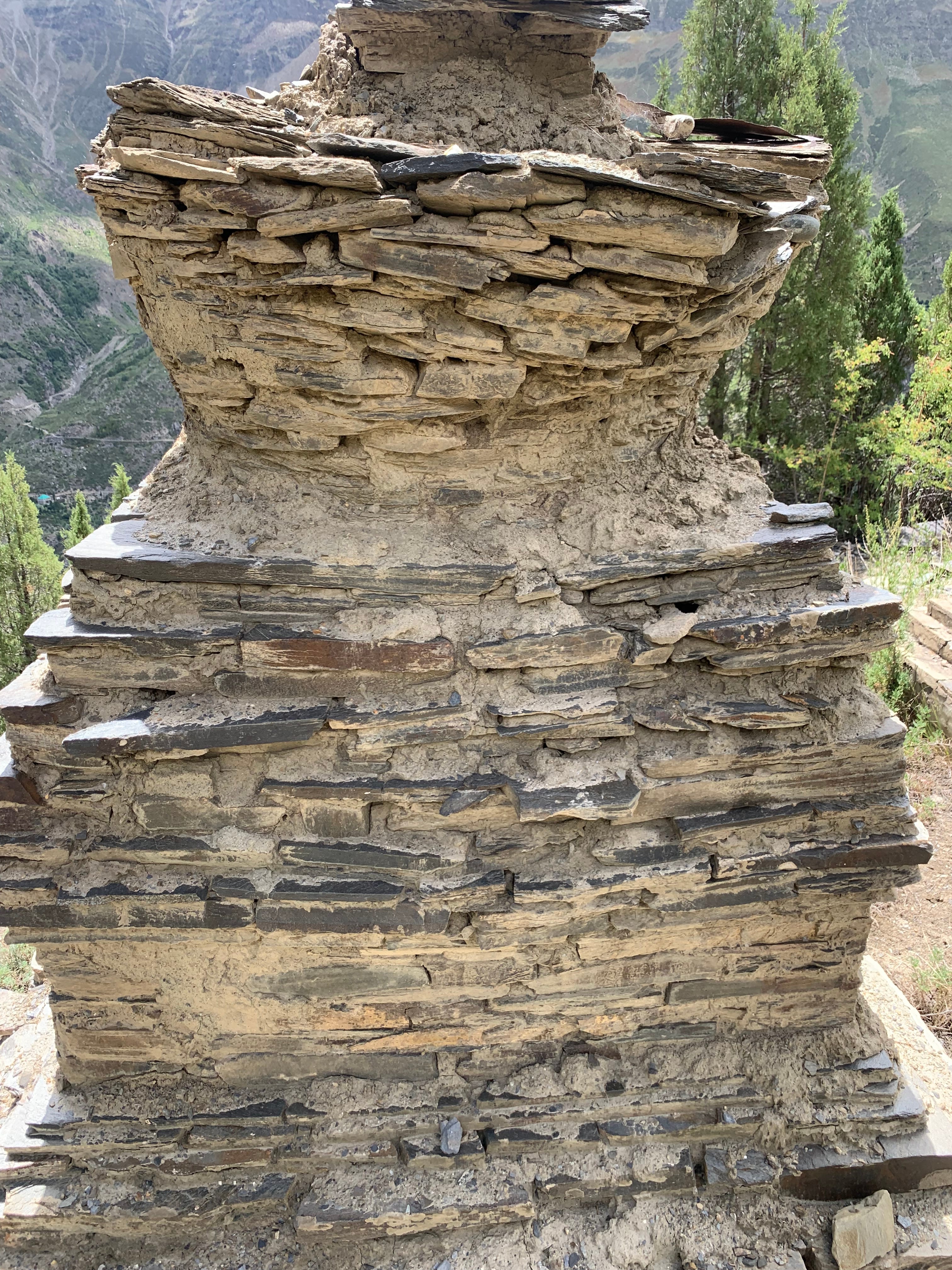
Here in Ladakh, many of the ancient Buddhist temples were originally Bon, the shamanic religion of these mountains that pre-dates Buddhism. You really feel connected to Deep Time visiting these sacred sites that rise right out of mountain rock, as if to emphasize the solid foundations laid by Shakyamuni Buddha 2500+ years ago.


What I’ve experienced thus far is that pilgrimage is one part accumulating blessings and merit by visiting and cognitively connecting with these amazing spiritual reservoirs, where I always try to offer up a mandala and absorb the cumulative contemplative energy of the place; while another part is finding supportive places for solitary retreat, in order to utilize those blessings as a force-multiplier for sadhana, or spiritual practice.
When it comes to hermitage and cave retreats, the Himalaya mountains themselves seem to play a pivotal role in shining all these anthropogenic lights out onto the world from on high. The caves function as Gaia’s womb, constantly giving birth to luminous and numinous awareness from the chthonic depths of Gaian consciousness, the psychosphere that pervades and acts as connective tissue for all that is alive. Deep time is quite palpable up here where the air is thin and the sedimentary layers of the ocean floor were thrust to the very top of the planet.
As I compose this, I’m sitting at 11,660 feet at the base of Shanti Stupa. Consciousness feels a little different up here! Speaking phenomenologically, of course. I know I sure feel different up here. Of course, I’ve never had this kind of opportunity to do extended retreat before - in this life, at least. The longest retreat I’ve ever done before this was one moon cycle. Now I’m on my fourth moon of retreat, and it’s a blood red lunar eclipse!
I feel incredibly privileged, to be sure. My life is pretty simple right now, and things are starting to take on a greater clarity to me after decades of serving on the front lines of Gaia’s nascent immune-defense system. The clarity is cognitive, but not necessarily conceptual, but it feels like a precious pool I can bath in and draw from.
I’m still not sure to what end, but at least I feel confident it will be coming from Gaia, blessed by my high lamas, and organismically sound. As a panpsychologist, I know how important set and setting are to sharing esoteric secrets and timeless truths. The table is set. Hopefully, my pilgrimage is beginning to make more sense to you, freeing me up to share more deeply.
In our next installment, then, we will progress from these exoteric insights to the more esoteric aspects of retreat. I will endeavor to share some secrets I’ve learned in my decades of regular meditation, studies, and retreat experiences. More than that, we’ll explore ways you can access these deeper and more subtle layers of collective consciousness yourself. That’s the beautiful thing about traditions like the Buddha Dharma, Taoism, and Advaita Vedanta ~ we are not required to re-invent the wheel! These vehicles that give so much meaning to the experience of life are available to one and all, no matter where your particular beliefs may lie or what your background might be.
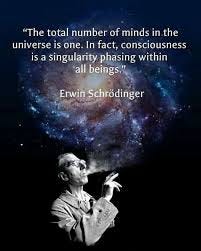
There is only one mind...
Hi Tham. We have had conversations before … about ocean currents etc .
But I wanted to congratulate you on this powerful sentence … “Deep time is quite palpable up here where the air is thin and the sedimentary layers of the ocean floor were thrust to the very top of the planet.”
I have spent about 4 months in the Khumbu / Everest region…of Nepal, manly in Lukla working as volunteer but also some trekking and having time to sit and do yoga and contemplate…. And have felt so much .. felt into the place .
… so I totally love that sentence and seek permission to use it with appropriate references in my own substack ramblings .
All the best with rest of your retreat . Mike
Another monumental dispatch from a monumental land! Filled with joy as I read. As if the act of being in communion with your via your writing means all is in fact well.