


“Everything is in destruction.
Everything is in construction.”
I began this year sharing some really positive developments from the climate front that came at the end of last year, still one of the most popular Dharma Beats:
TRANQUILITY IN DISTURBANCE 2025
Looking Beyond the Matrix
As we approach the Summer Solstice, and I prepare to go into deep retreat after meeting His Holiness the Dalai Lama (!), I feel like there has been so much already this year to add to that New Year’s list of positive signs: the cosmic tide is turning!

I heard one political commentator characterize this past weekend as “an extraordinarily positive turn of events” in the Trump 2.0 regime. DJT looks weaker than ever, and the show of force from 5+ million Americans who took to the streets reflects a new resolve to resist authoritarianism. This is right in line with the cosmic pivot so many of us have been pointing to with ALL the outer planets entering new constellations in stunning astrological symmetry. See, e.g.: here and here.
We could literally see and hear that sudden pivot last weekend with that squeaky-wheeled tank on a virtually empty Constitution Avenue, as Trump publicly sulked, no doubt wondering what happened to all that cosmic momentum he was carrying back when Pluto was in Capricorn, and his resurrection ripened into an improbable second term for a convicted felon, sex assaulter, and traitor.
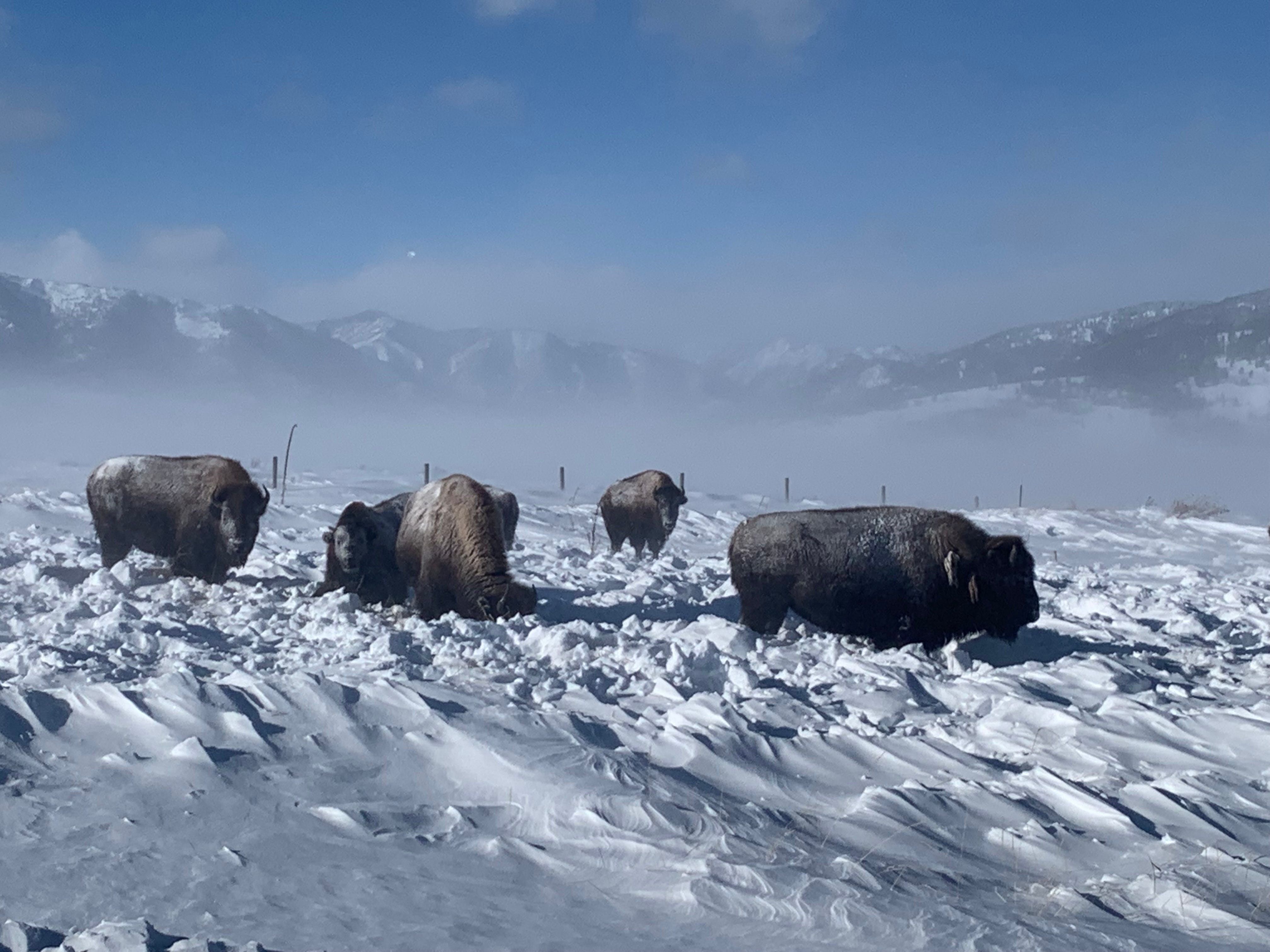
Now let’s look much deeper into the shifting zeitgeist. You’ll note the picture of wild bison above, unbothered by the bleakest landscape imaginable - it was minus-50F (-46 C) when I snapped that shot in the Yellowstone ecosystem a few years back. Take a moment to zoom in on those faces for full shamanic effect (esp. 2nd from left).
Bison are a climate keystone species in more ways than one!
Not only can they sequester enormous amounts of CO2 into the lithosphere if we let them roam free on abundant, available, degraded grasslands, they also can teach us how to face into the coming storm, which is their natural instinct. There’s a reason so many Indigenous people on Turtle Island thought of themselves as “Buffalo People,” and made bison the lodestone of their lifeways. Buffalo shaped this land. By the rights of nature, biospherically speaking, it belongs to them, not us. It is no coincidence that our survival now depends on restoring this keystone species to the land, thus atoning for the sin of ecocide as a corrective to our CURRENT ecocidal ways!

One of the stories I shared with you in that J1 Tranquility post was that $100 Million had just been set aside by the Department of Agriculture to support Tribal restoration of bison herds - an effort I was working on when that picture was snapped - for the express purpose of rejuvinating mixed-grass prairies.
This Tribal restoration initiative taps into the potential of bison to draw down twice the amount of CO2 every year than what we currently emit. That’s called reversing global warming, and Tribes hold the key. It’s their sacred relationship with buffalo and place that is the beating heart of rematriation and the “Land Back” movement (which is about control, btw, not ownership). The 3 R’s: Restoration, Reparation, and Regeneration; all necessary components of humanity coming back into proper relationship with Mother Earth.
So I was thrilled to come across this amazing piece of journalism recently, which weaves together all the positive developments that are happening on this, the grassy frontlines of the climate movement. It’s from an Indian (not American!) reporter, Esther Evangeline, a zoologist and writer working with a German group called “Animals Around the World”:
Bison Are Migrating Along Their Prehistoric Routes Again
This reportage is by far the most informative and comprehensive story I’ve come across yet about this critical effort. By painting the big picture, Evangeline accomplishes what UK climate journalist Matthew Green is now calling “trauma-restoring journalism,” meaning stories that actually contribute to healing generational traumas, and thereby help to resolve the climate crisis itself (see, below).
YUGE props to Ms. Evangeline. I find the format quite stimulating as well - 15 slides each weaving together a different thread in the tapestry. And I can tell you this is just the start. I have my ear to the ground (cultural appropriation!), and am hearing of big, earth-shaking (literally) developments to come in the next couple of years, and there is nothing really that little big man Trump will be able to do to stop the original, non-immigrant Americans from asserting their sovereignty over buffalo on public lands. So yes, for the first time since I began writing about the climate crisis over a decade ago, I can now say to you that there is hope on the horizon. Maybe not “ride off into the sunset” hope, but at least “facing the storm” hope.
Now let’s move on to some related recent developments I’m psyched to share with you, my poor beleaguered fellow humanists.
Rx: Climate Trauma
Query: What is the cure for climate trauma?
It’s a trick question! Climate trauma is both the sickness and the cure!
What do I mean by that?
Have you any personal experience with individual trauma in your life? If so, then you will know that unacknowledged trauma is unresolved trauma, and the mere act of acknowledging your trauma was both the bravest and the most salutary action you or your loved one ever took. It’s pretty amazing, isn’t it? As soon as you acknowledge it, trauma begins to resolve.
Sure, you have to do hard work in order to fully bring it up for healing, to become whole again. But it’s almost like once you acknowledge it, there’s no choice but to address it. It’s hard to unsee! And by addressing it, by grieving over what was lost, and lamenting the tragedy of lost opportunities, trauma is released. Once released, like a dam breaking, it frees up all this other energy and re-opens information loops between your psyche and your body, by which you feel more whole again (psychophysical).
Does that sound like your personal experience with healing trauma?
Climate trauma is a global, biospheric form of trauma on the immensely beautiful body of Mother Earth, which includes us, and it’s attributable to our actions and inactions. We’re just starting to acknowledge this. You could almost say we are still in the “sexual dysfunction” stage of our collective, climate trauma, where we’re still stuck in the self-destructive patterns by which we act out the trauma(s) we long ago suffered and suppressed. We could use a good intervention.
Most people, especially in the media, still prefer to speak of “climate change” (which term originated from a right-wing think tank to promote denialism) and “climate anxiety,” rather than to acknowledge climate trauma. It’s a reflexive way of externalizing the experience, pretending that it’s happening somewhere else, to someone else, and not in your home. But how could something as momentous and all-consuming as climate, or biospheric, trauma be anything other than a personal crisis, especially for those who are complicit, if not actively perpetrating it?
So the good news here is that unabashedly woke people are now acknowledging climate trauma - not quite at threshold levels, perhaps. But we’ll get there, too.
The Princeton University Press featured an essay in April by M.D. Usher, the Lyman-Roberts Professor of Classical Languages and Literature at the Univ. of Vermont, and a member of the Department of Geography and Geosciences as well. Got that? He’s both a linguist and a geoscientist! So we can consider it official when Usher states at the very outset of his thoughtful essay, “Fire sermons: Seneca and Thoreau on climate trauma”:
“Climate trauma” is a phrase that has now entered
the global lexicon.
As the author of “Climate Trauma: Towards a New Taxonomy of Traumatology” (2019), I really want to thank Prof. Usher for that! As I stated at the outset of that peer-reviewed paper, “the climate crisis does not just induce trauma under certain circumstances — it is a new form of trauma that pervades the circumstances of our life.”
Similarly, Usher points out we have no real precedent for this affliction, that “climate trauma is something else altogether. It is not a psychological or behavioral affliction arising from some innate disposition, social conditioning, or malfeasance, but a tangible, involuntary outcome caused by accumulated external factors.” Professor Usher goes on to cite a rather shocking study from one of the recent “climate fires” (I refuse to call them “wild,” b/c wildfires are natural) in northern California:
A recent study, purportedly the first to examine the cognitive and neural impacts of climate trauma, concluded that individuals exposed to the Camp Fire are suffering from what its authors describe as “significant cognitive deficits” stemming from the experience quite beyond the symptoms of post-traumatic stress disorder (PTSD) that one might expect. To put it coarsely, victims’ brain functions were fried along with everything else.
Again, this is just not another form of trauma. It’s a NEW kind of trauma, and that’s the key to acknowledging rather than dismissing or normalizing it. In that same study, researchers were even more surprised to learn that people who were in the secondary zone of influence, friends, family and even those who’d simply followed it closely in the media, showed MORE symptoms of trauma than the victims themselves!
Those directly exposed to the fire scored an average of 10.1 on anxiety and 8.9 on depression, compared to 9.7 and 11.8 for those indirectly exposed...
(Time Mag. 2023). What more proof could there be that climate trauma is a malady we all share with Earth, and not just the result of personal exposure?
Usher concludes, poignantly:
But it does not take a peer-reviewed, clinical study to understand that traumatic experiences change us. What we do with trauma, however, whatever its source, is the decisive criterion.
In other words, now that we’re beginning to acknowledge it for what it is (and isn’t), now that we’re feeling it and cognizing it, the process of resolving climate trauma can begin.
So perhaps it’s worth repeating my own conclusion from 2019 to reinforce this pivotal point:
As we humans are ourselves an integral part of the biosphere that is under assault, and are wholly dependent upon the natural world in which we have evolved, there is no protecting us from this sweeping assault on the life-support system we share with all beings. The logical implication, then, is inescapable: The global climate crisis needs to be seen as an entirely new and unparalleled kind of trauma. It appears to us as an unfolding cascade of unnatural (or at least anthropogenically induced) events that are placing unprecedented, almost inconceivable — but clearly lethal — stressors on the entire biosphere. Included in this sphere of influence are our own bodies and minds. It is a crisis of our relationship with nature that, naturally affects us at all relational levels—interspecies, sociocultural, com- munal, occupational, and familial. It also affects us at the level of individual psyche, which is at least related to, if not intimately connected with, Earth as a living organism herself.
***
In the Grail Legend that was the basis for T. S. Eliot’s epic poem ‘Wasteland,’ the melancholic, dying natural world of the fisher king is restored when the knight Perceval asks the mortally wounded king the simple, heartfelt question ‘What ails thee?’ What ails humans today, in our dying natural world, our home, is a pervasive and quickening trauma that, though it is triggering all our other traumas, has yet to be acknowledged.
Until now!
I feel heartened to say that psychologists around the world have read my paper, and so many have heeded its call. Even the historically staid American Psychology Association, whose position on the climate crisis I was criticizing in that 2019 paper, responded with a 2nd Report from their Climate Task Force in 2022 that called for politically engaged actions from psychologists in their communities, and it has since cited my paper on its climate distress resource page. As an ecopsychologist, it doesn’t get any better than that!
Quantum Leaps in Understanding
I am also happy to report on the publication of two significant, peer-reviewed academic papers that will help scale up this process of acknowledging the pervasive influence of climate trauma, and thus unleash more energy towards ultimately resolving our shared, collective traumas. Both of these papers, by the way, are also responsive to that other development from late 2024 that I reported on at the start of 2025: the IPBES Transformative Change Assessment, a catalyst for the quantum social change needed in response to our existential crisis.
The first paper, from two self-described activist-scholars, Sandra Engstrom from the University of Stirling, Scotland, and Amy Krings from Ohio State University’s College of Social Work, provides “A Framework for Trauma-Informed Climate Research: Interrupting the Relationship Between Climate Trauma and Social Inertia.” This new framework for conducting research in various fields is intended and designed to overcome the social inertia that plagues the world in today’s toxic political climate.
The second paper, published by the Cambridge University Press at the start of the year, reinforces the first: “Climate change trauma and collective dissociation: Unraveling the impact on mental health and advocating for collective action.” There is a nice synergy between these two papers and the Transformative Change Assessment.
Rather than get too wonky here - and I encourage you to read these papers yourselves, as they’re fairly brief for academia - I’m just going to share some juicy quotes from these papers, sans citations (including to my own and Steffi Bednarek’s seminal work), that should help to bring climate trauma into sharper focus:
“A defined traumatic event or a continuous long-term process can be defined as cultural trauma. Cultural trauma, which we, and others, argue climate trauma increasingly is, is a social process involving the systematic disruption of the cultural basis of social order, due to a collective wounding (e.g., terrorist attack) and calls into question who we are as people. Left unresolved, these traumas can change a society’s identity and meaning...” [Engstrom/Krings]
“As the world grapples with the escalating impacts of climate change, a unique form of trauma, known as “climate change trauma,” is emerging. Unlike traditional trauma, which is typically experienced at the individual level, climate change trauma permeates entire communities and societies.” [Shomuyiwa et al.]
“This phenomenon leads to what is termed Collective Dissociation, a coping mechanism for the overwhelming global trauma inflicted by climate crisis-induced disasters. Addressing the full spectrum of mental health responses to climate change requires a holistic approach that integrates biological, psychological, behavioral, and social dimensions. This approach is essential for developing effective strategies for adaptation and resilience, as well as promoting collective action.” [Shomuyiwa]
“Moreover, the climate crisis fundamentally represents a crisis of relationships. The disruption of natural systems parallels the disruption of social and psychological systems, creating a profound relational crisis between humans and the planet, as well as within communities globally.” [Shomuyiwa]
“The existential threat posed by climate change to global biodiversity and shared identity deeply impacts human minds. As members of the biosphere, humans experience overwhelming stress from the perceived lack of protection against environmental assaults. Climate trauma can trigger past personal, cultural, and intergenerational traumas, leading to psychosocial defense mechanisms that cause populations to recoil from the climate crisis implications.” [Shomuyiwa]
“The climate crisis, and subsequently responding to it, signifies a profound symbolic challenge to the existing social order. Societies have become addicted to overconsumption, which ensures we are focusing on short-term gains in exchange for long-term consequences. The powerful unconscious effects of the previous traumas contribute to overconsumption, extraction, and exploitation, and we are still in a process of awakening to the true impact of these behaviors.” [Engstrom/Krings]
“[A] trauma-informed research approach can help researchers and participants identify hegemonic beliefs, attitudes, and behaviors that contribute to the Earth’s destruction. These include dominant beliefs about modernism, individualism, and capitalism that are embedded in structures, policies, and discourses that pervade our everyday lives. With a clearer understanding of how these hegemonic beliefs manifest in individual routines as well as political, economic, and social structures, participants are better able to critically question and challenge or replace them with a belief system that centers an ethic of care (IPBES, 2024).” [Engstrom/Krings]
“Collective dissociation hinders effective climate action. To create a safer climate environment, we must address the mental health impacts of climate change and understand the collective trauma response. A shared lack of awareness diminishes the transformative power of collective action, posing a dangerous threat to climate initiatives. This is a compelling call to action to proactively address these mental health implications. By leveraging research, advocacy, policy development, and collaboration, we can mitigate the impact of collective dissociation on health systems and strive for a more resilient and sustainable future.” [Shomuyiwa]
How cool is that?
And this brings us full circle to one of the more crucial developments/adaptations that is just now beginning to emerge, to take shape and form, which I alluded to earlier:
Trauma-restoring media
I’ll have much more to share on this topic, maybe in the next Dharma Beat, but I just want to leave you with one other sterling example, this one from none other than the NY Times! And as with all the other developments listed above, I’m happy to report that I played a small role in this one as well. Due to confidentiality, that’s all I can really say about that.
The NYT has launched an investigative, collaborative series called “50 states/50 fixes” ~ which resonates rather nicely with the 50/50 solution (protecting/connecting 50% of Earth by 2050) to the climate crisis, don’t you think? It focuses on local climate solutions, or what is happening on the ground. This is pretty progressive from a legacy media outlet like the Grey Lady, and while they’re not expressly labeling it “trauma-restoring journalism,” that’s what it is!
I want to bring just one of the 50/50 state efforts to your attention. And just for perspective, here was the last point being made in the Tranquility Beat:
Joanna Macy teaches us that the Great Unraveling and the Great Turning are simultaneous processes. It seems like the unravelling is happening above us, however, grabbing all the headlines - because we’re hardwired to focus on threats - while the Great Turning is happening largely unseen, beneath our feet, quite literally at the grass roots level.
The Hawaii NYT installment is about a mental health clinic, the Ho‘oulu ‘Āina, where the patients have received great therapeutic benefit from coming into sacred relationship with the land by restoring a trashed landscape into a nature preserve! The NYT story tells of people healing their personal trauma by healing land, with one of them saying about the preserve: “My whole existence was just pain and trauma, and this was the first place that I felt any type of healing taking place...”
Scale that up, and you get projects like the bison restoration, or restoring sacred relationship between humans, oceans and whales, which has even greater potential for CO2 drawdown than grasslands ecosystem restoration by bison.
This is what the half-Earth proposal for curing climate trauma is all about. It’s our future. It’s holistic.
Please note that I’m well aware of the collapse that’s unfolding all around us at the same time I am writing about regeneration. In fact, I will give Professor Usher the last word on this point, which will bring us full circle to the quote about Tranquility in Disturbance:
“[C]ollapse is not a bug. It is, as Seneca also insists, a feature of all systems. But that is not a fatalistic assertion. It’s just the way things are — which we would do well to remember now, today. There is a positive role for us to play in the unfolding drama of complexity. Indeed, as Seneca himself says about the fate of Lyon, “Often a catastrophe has simply made room for greater prosperity.”
This is a brilliant article on Healing, Climate Cures and spirituality! Peace!